
The Layoff Trap
Why the debate over AI jobs displacement may have nothing to do with AI

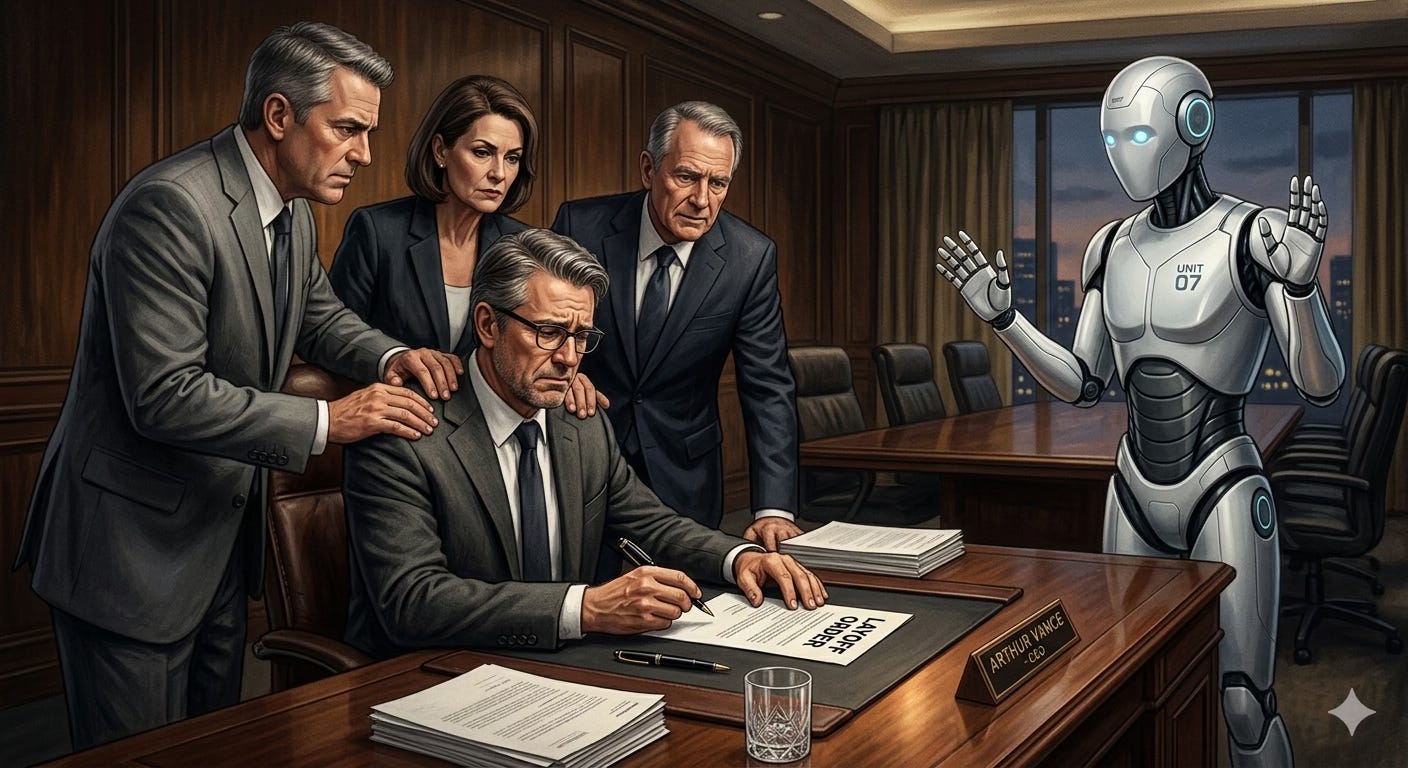
When Layoffs Were Confessions
Not so long ago, there was a simple cultural rule about layoffs: healthy companies don’t do them.
Layoffs were a signal. Not of strategy — but of distress. Something had gone wrong. A bad bet, a market that hadn’t opened, a quarter that couldn’t be explained away. The companies you used to read about cutting workers were the ones in trouble, and everyone understood it that way. There was a moral logic to it, and it was more or less coherent: the company had no other choice. That was the only story available.
I certainly don’t want to romanticize the era. Companies weren’t always honest about necessity versus preference. Plenty of people lost jobs they shouldn’t have lost, under cover of that language. But the norm itself was real. It placed a burden of justification on the company. You owed an explanation for why there was no other option.
That norm started fraying in the early 2010s, as activist investors pushed healthy companies to treat headcount as a variable rather than a commitment. The pandemic finished it off. Companies hired fast when they thought the world had permanently changed, cut fast when it hadn’t, and watched their stock prices rise during both.
What got absorbed — quietly, without announcement — was a lesson: the relationship between workforce size and company health was more elastic than anyone had previously admitted out loud.
Workers who had built their lives around an implicit promise of stability discovered, in real time, that they were inventory.
By 2023, the vocabulary had changed. Not layoffs — “restructuring,” “right-sizing,” “strategic workforce realignment.” Language doesn’t shift unless the underlying social reality has already shifted first. Companies needed new words because the old ones still carried moral weight they were no longer willing to carry. They were profitable. They weren’t in trouble. The confession frame no longer fit.
The Moral Inversion
What AI has done is complete the transformation. It hasn’t just given companies a neutral vocabulary for cutting workers. It has given them a virtuous one.
When Block laid off nearly half its workforce earlier this year, Jack Dorsey didn’t issue a statement of regret. He co-authored a philosophical essay. His argument: corporate hierarchy had become obsolete. AI could now handle the coordination work that management layers used to provide. Leaner, smarter organizations were the ones that deserved to survive. The layoffs weren’t the story. The essay was the story. Publishing the essay was the point.
I think this matters more than it first appears. Dorsey isn’t wrong about everything — AI genuinely is changing how coordination happens inside organizations.
But the transformation of a mass layoff into a manifesto does cultural work that goes beyond the specific case. It makes the next round easier. It extends permission.
And permission, once extended to one healthy profitable company, spreads to the next board that needs a story to tell about the future.
The specific claim now widely available — that cutting workers is an act of organizational vision, that the CEO who automates fastest is the leader and the one who hesitates is the laggard — is not cynical in the way the old euphemisms were cynical. It is genuinely believed by many of the people making these decisions. That is what makes it durable. And durable beliefs, in competitive markets, become self-fulfilling.
The Fear Underneath the Noise
Here is where I want to slow down, because I think the public conversation about AI and jobs is conflating two very different concerns.
The first concern is the one everyone is shouting about: that AI will literally replace individual workers, task by task, role by role. This is the concern that animates the think pieces, the Senate testimony, Dario Amodei’s warnings, the anxious LinkedIn posts. It is a real concern. But it is, at its core, a concern about individuals. Will my job survive? Will yourprofession exist in ten years?
The second concern is much bigger and, I think, much less discussed. It isn’t about any individual losing their job.
It is about what happens to an economy when enough people lose their jobs at the same time — not because AI was ready to replace them, but because competitive pressure made companies feel they couldn’t afford to wait until it was.
That is a different kind of danger. It is diffuse, structural, and — this is the part that should concentrate our attention — it has a mechanism. A formal one. And the mechanism doesn’t require AI to be very good. It only requires that enough companies believe their competitors are already moving.
The Trap
A pair of researchers at the University of Pennsylvania and Boston University recently published a formal economic model of what happens when firms in a competitive market simultaneously replace workers with AI. Their finding is not that this is bad for workers. That was already understood.
Their finding is that it is bad for everyone — including the firms doing the replacing — and that knowing this isn’t enough to stop it.
The mechanism works like this. A firm replaces workers with AI. Costs drop. In a competitive market, those savings flow into lower prices, which wins market share. So far, rational.
But the displaced workers were also consumers. Not necessarily customers of their former employer — but customers of someone. When they lose income, they stop spending. Aggregate demand across the broader economy contracts. The automating firm captures all of its own cost savings. It bears almost none of the demand destruction it causes. That destruction lands diffusely, invisibly, on everyone else.
Every other firm now faces the same calculation. Automate and capture the savings, or hold back and lose margin to the ones who don’t. There is no stable middle position. Restraint isn’t a strategy when your competitors aren’t restraining. So every firm automates. They all know what they’re collectively doing. They do it anyway.
Call it the Layoff Trap. Not a metaphor — a structure. Individual rationality producing collective harm, in a way that no individual firm, and no coalition of firms, can break from the inside.
And here is the finding I think deserves the most attention: better AI makes the trap worse, not better. As the technology improves, productivity gains grow, the incentive to automate strengthens, and the gap between what each firm does individually and what would be good for all of them widens. The researchers call this the Red Queen effect. Running faster makes the race more destructive, not less.
Why Nothing Fixes It
The natural response is to reach for solutions. The researchers evaluated six. What they found, in every case but one, is that the proposed remedy addresses what happens after firms over-automate — not the competitive incentive that makes them do it.
Give displaced workers more money — through universal basic income or similar programs — and you help the people who lost their jobs. You don’t change the calculation facing the firm that cut them. The pressure to automate comes from competition, not from indifference to workers. A check from the government doesn’t make automating any less attractive relative to what the firm next door is doing.
Retrain the displaced workers. Same problem. You’re helping people land after the fall. You’re not changing anything about the fall itself.
What about making workers part-owners, so they share in the gains from automation? It narrows the harm. It doesn’t break the competitive logic. What about taxing the profits that come from automation? Profits are the wrong place to intervene — by the time you’re taxing profit, the decision to automate has already been made and the workers are already gone.
Collective bargaining is the most instructive failure of all. The idea would be that companies agree among themselves to go slower. But think about what that requires. Every firm in a sector would have to trust that every other firm was holding back too. And any firm that broke ranks — that automated while the others waited — would gain an immediate advantage. There is no way to make that agreement stick. The race continues whether anyone wants it to or not.
The researchers found exactly one instrument that actually addresses the problem at its source: a tax on each automated role, set at the level of economic damage that displacement causes, so that firms bear the cost they currently pass on to everyone else. It is, as far as the model goes, the correct answer.
It is also, in the current political environment, approximately impossible.
The Window
I’m not saying the economy is about to collapse. The researchers themselves describe their model as identifying a structural vulnerability rather than diagnosing a current crisis.
Displaced workers are being reabsorbed at a pace that has, so far, roughly kept up with displacement. We are not in freefall.
But I think this is a specific kind of problem — one we have some experience recognizing, and considerably less experience acting on before it’s too late. It is the kind of problem where the mechanism is clear, the math is not complicated, the harm is diffuse enough that no individual actor feels it directly, and the moment when something could have been done always turns out to have been slightly earlier than we thought.
It could be that climate change is the right comparison here.
Not because the outcomes are equivalent — they’re not — but because the structure is familiar. In both cases, the mechanism is proven and the math is accessible. In both cases, no individual actor experiences the full cost of their own contribution. In both cases, the collectively rational solution requires a level of coordination that fragmented, competing interests have not managed to produce. And in both cases, the window for relatively cheap correction is finite — and closes while we are busy arguing about whether the problem is real.
The public conversation about AI and jobs is focused almost entirely on the capability curve: is AI good enough yet to take this job, that profession, this industry? It could be that this is the wrong curve to watch. The more consequential one may be the competitive one — how many firms, in how many sectors, have already decided they can’t afford to be the last one to try.
The doomsayers may be right about the outcome and wrong about the cause. The trap doesn’t need AI to be good enough to replace everyone. It needs AI to be good enough that no firm can afford to be the last one to find out.
Sources and Inspirations
The economic model underlying this essay is drawn from “The AI Layoff Trap” by Brett Hemenway Falk (University of Pennsylvania) and Gerry Tsoukalas (Boston University), published March 2026. Their formal proof that competitive demand externalities trap rational firms in over-automation — and that only a Pigouvian tax corrects it — is the structural argument this essay is built around.
The Block layoffs and Jack Dorsey’s “From Hierarchy to Intelligence” essay, co-authored with Roelof Botha of Sequoia Capital, were published March 2026 and covered by Bloomberg, Fortune, and CoinDesk. The Shopify memo from CEO Tobi Lütke directing employees to justify new hires against AI alternatives was published in 2025 and widely cited through 2026 as a marker of the shift in corporate hiring philosophy.
Dario Amodei’s January 2026 essay “The Adolescence of Technology” warned that AI displacement would be “unusually painful,” “much broader,” and “much faster” than previous technological shocks. Erik Brynjolfsson, Bharat Chandar, and Ruya Chen’s work on employment effects in AI-exposed sectors documents the disproportionate impact on entry-level and younger workers.
The broader pattern of profitable companies conducting strategic layoffs through the post-pandemic period has been documented by the Wall Street Journal, Financial Times, and Challenger, Gray & Christmas, whose March 2026 report attributed roughly a quarter of U.S. job cuts that month directly to AI.